

Note that this post is written under the assumption that I am not addressing enjoyers of “storygames” nor non-storygame DMs that nevertheless intentionally guide players along a predetermined narrative for whatever reasons.
Neither of those scenarios are relevant to this writing.
Dungeons & Dragons and similar TTRPGs are multi-faceted games: they usually involve a mix of luck, planning, narrative, and imagination that varies depending on the game or table in question. However, while rolling dice and immersing in the fantastical are fine features, I believe it’s fair to say that, above all, these are games about making decisions. This begins with a player deciding their starting spells and equipment and may end with making the final choice that seals their doom. Consequently, one hallmark of a successful DM is the ability to maximize player agency, which is really just another way of saying “maximize the opportunities for decision-making.” I would argue that the player-driven “sandbox” style of campaign is the purest expression of this ethic but, in this post, I will share some of my specific decision-fostering principles that other DMs can observe regardless of the wider context of their game sessions.
Make Information Available
Informed decisions are better decisions. If players lack sufficient information for their decision-making, then what they are really doing is guessing. While the occasional player might be fine with cavalier gambling, most are probably more invested in a positive outcome, whether it be conquering a one-shot adventure or attaining power and renown in an ongoing campaign. Such players will only have so much patience for repeatedly throwing caution to the wind and letting the dice decide. Their engagement and satisfaction with your game will likely increase the more often you give them a chance to make an informed decision.
How? Well…
Don’t deny players the tools that already exist in the game. Divination spells. Sage research. Greasing palms at the local tavern. Befriending a knowledgeable dungeon faction. All these things should have a cost in gold, time, spell slots, or services-in-kind, and it’s not the DM’s problem if players choose not to pay. Likewise, if players come up with clever or costly ways to garner information which were not anticipated by you or explicitly outlined in the rules, then give them what they seek. This may require you to think on your feet: maybe it didn’t occur to you that the players might try searching for traps or secret doors by scanning the walls with a Wand of Metal and Mineral Detection, but if it seems plausible that the relevant mechanisms might be metallic, then grant them that detail. They can then make a more informed decision as to whether they want to risk additional time disarming the trap or searching for the secret door trigger.
Intentionally telegraph. Sometimes there may be no plausible way for players to gather solid information in advance regarding a specific trap, a novel monster, the hidden motivations of an NPC, etc. This is where a DM should consider providing clues. Maybe after seeing the gouges in the wall, the players decide to crawl across the floor in case there might be an arrow trap across the room. Maybe the visibly dripping mandibles are enough to make the players decide to run from the unfamiliar monster if they have no defense against poison. Maybe the fact that the sheriff seems to enjoy a lifestyle above his station indicates some shady revenue streams…and if the players decide not to investigate him further, then their decision is to blame if he later jails them on behalf of a sinister benefactor. A rule of thumb some find useful: the more dire the hazard, the stronger the telegraph.
Tell them what they see, hear, and smell. You already know what is on the page of the module and maybe you even wrote it yourself. Because of this, you must be wary of assuming the players can envision the scene just as easily. Does this mean every new locale should begin with a laborious description of every detail present? No, quite the opposite. The description should be brief and contain pointed hooks for further investigation; its very digestibility is what keeps the signal from being lost in the noise.
Compare the following spoken descriptions of the same room:
1st: Opening the door, you see no movement in this 30’x20’ room nor do you hear any sounds. Amidst some scattered junk, one thing stands out: a closed chest.
The players are most likely going to go straight for the chest. At best, maybe they check it for traps first and then take the meager treasure inside. They are likely never going to find the secret door in the northwest corner that leads to the good loot because they have no reason to look there. If they are the type of players that make a habit of searching every nook and cranny for secret doors by default, then you’ve already made the mistake of not properly imposing penalties in the form of wandering encounter checks (and thereby robbing them of yet another decision: is checking for secrets here worth the risk of another fight?).
Oh, and the players are going to be really pissed when the giant spider on the ceiling drops on top of them with no warning.
2nd: Opening the door, you see no movement in this 30’x20’ room nor do you hear any sounds. The majority of the floor is covered in shattered crockery, a few pieces of stained armor, and what looks like bits of broken furniture, all covered in a dense layer of cobwebs. Perhaps this once was a place where meals were eaten. A wooden chest sits invitingly amongst the ruin. Its metal bindings are tarnished with age, but the wood is carved with intricate engravings of fey beings cavorting amongst floral fields.
In this case, we have single clue that might warn players of the impending spider ambush, but it is utterly buried in a description that calls attention to details that, while they might help set the scene, have no bearing on the decisions that need to be made. Many of these details are best reserved for helping frame the scene in the DM’s mind and should be omitted from the initial description spoken to the players, though they can be offered later if the DM is subsequently asked questions about specific details of the room. Indeed, I think evocative description is commendable as long as it takes a back seat to player agency.
3rd: Opening the door, you see no movement in this 30’x20’ room nor do you hear any sounds. Struggling to peer past the dense cobwebs dangling from the ceiling and coating the room’s contents, you see that, with the exception of the northwest corner, the floor is mostly covered with scattered debris, though an engraved chest stands out amongst the useless junk.
I think this description achieves balance. I bolded the terms that should catch the players’ attention and invite decision points of further investigation or dismissal. They can burn time investigating the debris if they like, but it should be clear that any additional treasure there is a long-shot. They can ignore the overt and upfront reference to the cobwebs and make straight for the chest, but if they decide to do so, then they have much weaker grounds for grievance about the spider ambush. If they paid enough attention, they also now have a clue on which to base their decision to search for a secret door in a specific area.
Let me be clear that the DM’s goal here is not to protect the players from the spider nor to ensure they don’t overlook a secret room. It also isn’t precisely about making situations feel more fair; I certainly don’t feel it is desirable to always force a parity between players and the adversarial game world. Rather, the intent is to tie outcomes to informed decisions as much as possible. If the spider kills a character with no available clue, the player, even if taking the death in good humor, is likely going to feel the death was unearned and arbitrary. If the player can look back and say, “Oh, I got greedy and chose to ignore the fact that the cobwebs were literally hanging in my face,” they are much more likely to feel that their own agency played the chief role in the outcome, however bitter a realization it might be.

Finally, note that the timing of telegraphing need not be so immediate as the example presented here. Perhaps some DMs would omit the local reference to the cobwebs and instead have an NPC back in town mention that the dungeon is riddled with giant spiders. However, if then the players insist on looking at the ceiling before entering every room and hallway, this risks replacing a decision point with a rote ritual that, in aggregate, can bog down the game. Fortunately, the defense against “ritualized” exploration is simple: convince the players they can trust you by providing evidence that you believe in the spirit of informed decisions! They will learn that the measure of their skill has more to do with their ability to spot clues and assess their relative value rather than how religiously they adhere to the tedious enactment of a routine.
Actions Have Consequences
Or at least, they should. This is a simple principle, but one that is essential to practice in the following forms:
Stop inserting trivial decisions into your games. If the players’ decision has no meaningful differences in outcome, then you should reassess whether that decision point should even be included. If the clever villain is going to stick to his exact plan no matter what the players decide to do, then why not just make him a mindless monster? What does it matter if the players spent time and resources finding out his weaknesses, spying on his minions, and undermining his allies? The payoff the players get from knowing they successfully threw a wrench into his scheme will be far greater than whatever grand denouement you had foreordained. Likewise, if the players choose to move against the villain rashly and without proper scouting, then don’t be afraid to make them feel the brunt of his wrath. Be generous with both your good and bad consequences, but strive to tie them to the players’ decisions.
Incidentally, this is one my fundamental complaints with many storytelling games and games with a focus on characters that have tons of “build” and combat options but are also nearly impervious to death or meaningful defeat. Yes, there are lots of decisions to make (often excessively so), but their consequences feel trivial. The stakes are not real.Don’t let players clutter the game with trivial decisions either. There is always that one player, God bless them, that wants to endlessly weigh the merits of taking or leaving behind some bit of useless dungeon dressing or engage in a protracted line of conversation with an NPC that everyone knows is never going to lead to useful decision-making information. You can indulge a bit if the table seems to be having fun with it, but usually these meanderings need to be mercilessly quashed for the good of the game. We’re not here to play magical tea-party, after all.
Stop rendering decisions trivial when they shouldn’t be. One of the most egregious examples is not properly making periodic or triggered encounter checks. Players decide to search for secret doors or traps: make a check. Players decide to stand around blathering about the exact minutiae of how they want to optimize the raid on the next room: make a check. Experience has convinced me that most DMs are not making nearly as many encounter checks as they should be, which means not enough player decisions are being made with consequences on the table. If there is no downside to checking every nook and cranny for traps and secrets, then why on earth wouldn’t players do so? There is no decision to be made in that scenario.
This point also ties into Gary Gygax’s infamous exhortation: “YOU CAN NOT HAVE A MEANINGFUL CAMPAIGN IF STRICT TIME RECORDS ARE NOT KEPT1,” now something of a meme in old-school circles. Though not his only concern in that passage, certainly part of what Gary was warning against was the tendency for many DMs to be lax about imposing the time-based costs that are supposed to be inherent in many player decisions. Robbed of the time consequences, these decisions, including travel, recuperation, and unnatural spell aging as well as downtime activities like item creation and spell research, lose a lot of their impact on a character that should be subject to the demands of a dynamic game world and the ticking clock of a mortal lifespan.
This is a Game, Games Have Rules, and Rules are Important Decision-Making Tools
If a player doesn’t know the game’s rules, they are not going to be making optimal decisions. However, this does not mean each player needs to be an expert. While having one proficient player in the party can certainly be helpful, most players, especially ones new to the game, are not going to approach the DM’s level of mastery. Consequently, I think there is nothing wrong with the DM giving the players rules reminders in-session. Is it a satisfying outcome if a player dies because he simply forgot that fleeing out of melee entitles the foe to an extra attack? Compare these two scenarios:
Scenario 1:
John: “My fighter’s AC is pretty good, and I can probably trade blows with this ogre for another round until Jane brings Friar Buck over here to heal me. But, eh, I’ll just run away and head towards Buck rather than risk it.”
DM: “Ok, the ogre takes its free attack with a to-hit bonus since you fled.” *Rolls a few dice* “Yikes, John, looks like your fighter is on the floor with his head caved in. Here’s a fresh character sheet.”
John: “What the hell? Seriously? Oh man, I can’t believe I forgot that stupid rule about the free attack. Actually, I can believe it; I’ve only been playing this game for a few months.”
Scenario 2:
John: “My fighter’s AC is pretty good, and I can probably trade blows with this ogre for another round until Jane brings Friar Buck over here to heal me. But, eh, I’ll just run away and head towards Buck rather than risk it.”
DM: “Hey, John, your fighter is indeed pretty stacked, but don’t forget that if you flee melee combat, the ogre is going to get a free attack and a bonus to his hit roll, so that may go poorly even with your good AC. In this case, it might actually be safer to stand your ground, but that’s up to you.”
John: “Dang, yeah, thanks for the reminder. I’ve got the general flow of combat down pat now but I’m still shaky on some rules. Maybe I should just stay here for now.”
Jane: “Sure, but I’m not crazy about moving Friar Buck that close to an angry ogre.”
DM: “Well, looks like you’ve got a decision to make, John.”
Regardless of how this fight plays out, which scenario do you think is going to be more satisfying to the table? Which feels more like a game of decisions rather than a “gotcha?”
This willingness to keep the players informed becomes even more important when the DM is modifying the rules or probabilities on the fly. Here is an example from the last session I ran earlier this week:
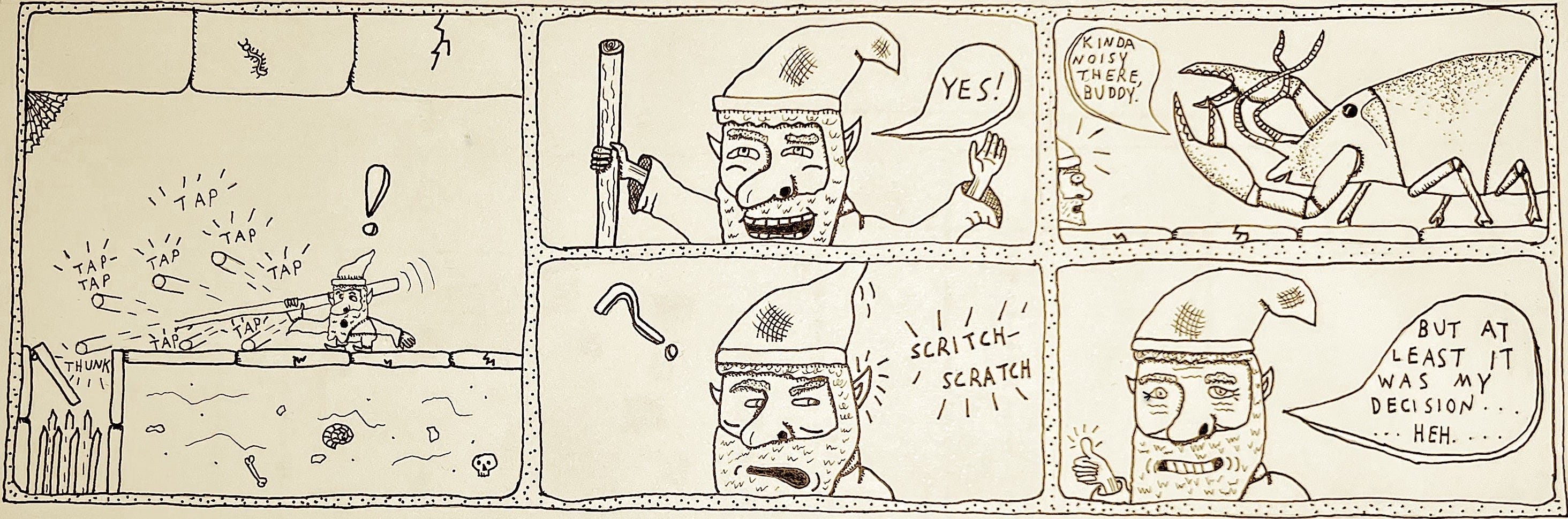
Ambrose the Gnomish Illusionist was highly suspicious of a long, empty hallway. He declared his intention to tap the walls and forcefully probe the floor with his ten-foot pole as he proceeded down the passage. I informed him that this was a fine course of action, but that this precaution would not only slow him down but would also double the encounter rate from 1-in-6 to 2-in-6 due to the noise. He decided to proceed as planned. As it turned out, Ambrose harmlessly sprung a pit trap for his efforts but also got a “2” on the encounter roll; a giant crayfish arrived and felled a henchman before it was slain. I made sure he knew precisely how I was going to modify the rules before he made his decision: a nebulous cause-and-effect had been expressed as a concrete rule the player could easily weigh.
Do the players need to know the exact math beforehand in every single scenario? Not necessarily, but this is a game, first and foremost, and it has rules. For me, it is perfectly fine to break verisimilitude in order to ensure the behind-the-scenes rules are understood before decisions are made.
Caveat 1: Nonetheless, there is entertainment to be had in surprise, in a game element doing something unexpected. After all, how could anyone possibly know ahead of time that the ancient thing guarding the tomb has the ability to step through walls and attack the party from behind? Maybe this can’t be known, and maybe it is best for the game that it not be known. Even so, question whether it is still appropriate to replace the awareness of the “rule” with some sort of information, even if is a bit removed from the decision point. Maybe the most the players get is a lone expedition survivor at the tavern, drunkenly raving about how the creature that slew his comrades was “everywhere all at once.” Maybe they don’t even get that much. That balance between the unknown and the “rules of the game” is a delicate one that the DM must navigate, but let the importance of decision-making be your guidepost.
Caveat 2: Don’t coddle players who are willfully lazy or disengaged. If a player has many sessions under their belt, and the DM is still having to stop the action to recite their class abilities or explain the same spell for the tenth time, then some tough love is in order. The play experience of the other people at the table must be considered.
Of course, no matter how well the static and dynamic rules may be known to the player, this obviously doesn’t ensure there is a clear right or wrong answer to a decision. Trade-offs are a real thing. Again, the goal is not to insulate the player from consequences, but rather to foster the feeling that these consequences are owned. Ownership cannot be genuinely felt by a player who doesn’t understand what is at stake.
A Negative Outcome Should Ideally Trace Back to at Least One Failed Decision Point
And the more failed decision points on the chain leading to the consequence, the greater the ownership of that outcome. Compare the following scenarios:
Scenario 1:
DM: “Despite the fact that the party is heavily armed and standing only a few feet before his throne, the Grand Wushi seems utterly at ease and simply sneers at your demands.”
John: “Oh, is that so? This smug chump is about to get a lesson in humility. I draw my sword and charge him!”
DM: *after the dice have settled* “So your fighter now has five daggers sticking out of his back and the last thing he hears is the Grand Wushi’s cackling as the rest of the party prepares to defend themselves from the bodyguard assassins that have now turned their attention to them.”
John: “Yeah, that was dumb. I deserved that. I should have known he had something up his sleeve if he was that confident.”
DM: “Live and learn, John. Well, more like ‘die and learn,’ but you get the idea.”
Scenario 2:
DM: “The Grand Wushi sneers at your demands.”
John: “Oh, is that so? This smug chump is about to get a lesson in humility. I draw my sword and charge him!”
DM: *after the battle* “So you remember how the Grand Wushi’s former gardener told you that the sorcerer never eats, sleeps, or takes a piss without his hidden bodyguards shadowing his every move? Yeah…..”
John: “Ugh…walked right into that one. Gotta pay attention to the details!”
DM: “Yep.”
Scenario 3:
DM: “The Grand Wushi sneers at your demands.”
John: “Oh, is that so? This smug chump is about to get a lesson in humility. I draw my sword and charge him!”
Jane: *after the battle* “John, you know that guy back in town that wanted to sell us information about his master? The one that claimed to be the Grand Wushi’s former gardener? Maybe we should have taken him up on his offer.”
John: “What?! That guy was sleeping in filth under a bridge and wanted a small fortune for his glorified gossip. How was I supposed to know he had valuable info?”
Jane: “John, you were being cheap.”
John: “Yeah, I guess so. Now I’m dead and you guys are locked in the dungeon…”
Scenario 4:
DM: “The Grand Wushi sneers at your demands.”
John: “Oh, is that so? This smug chump is about to get a lesson in humility. I draw my sword and charge him!”
John: *after the battle* “What was that crap? ‘Ninjas appear. Everyone dies.’ C’mon, man…no one else was in the room.”
DM: “Sure they were. They were just hidden.”
John: “Lame.”
DM: “Hey, look, you knew the Grand Wushi’s manse was a dangerous place when you decided to come here. You could have stayed behind in town if you wanted to be safe.”
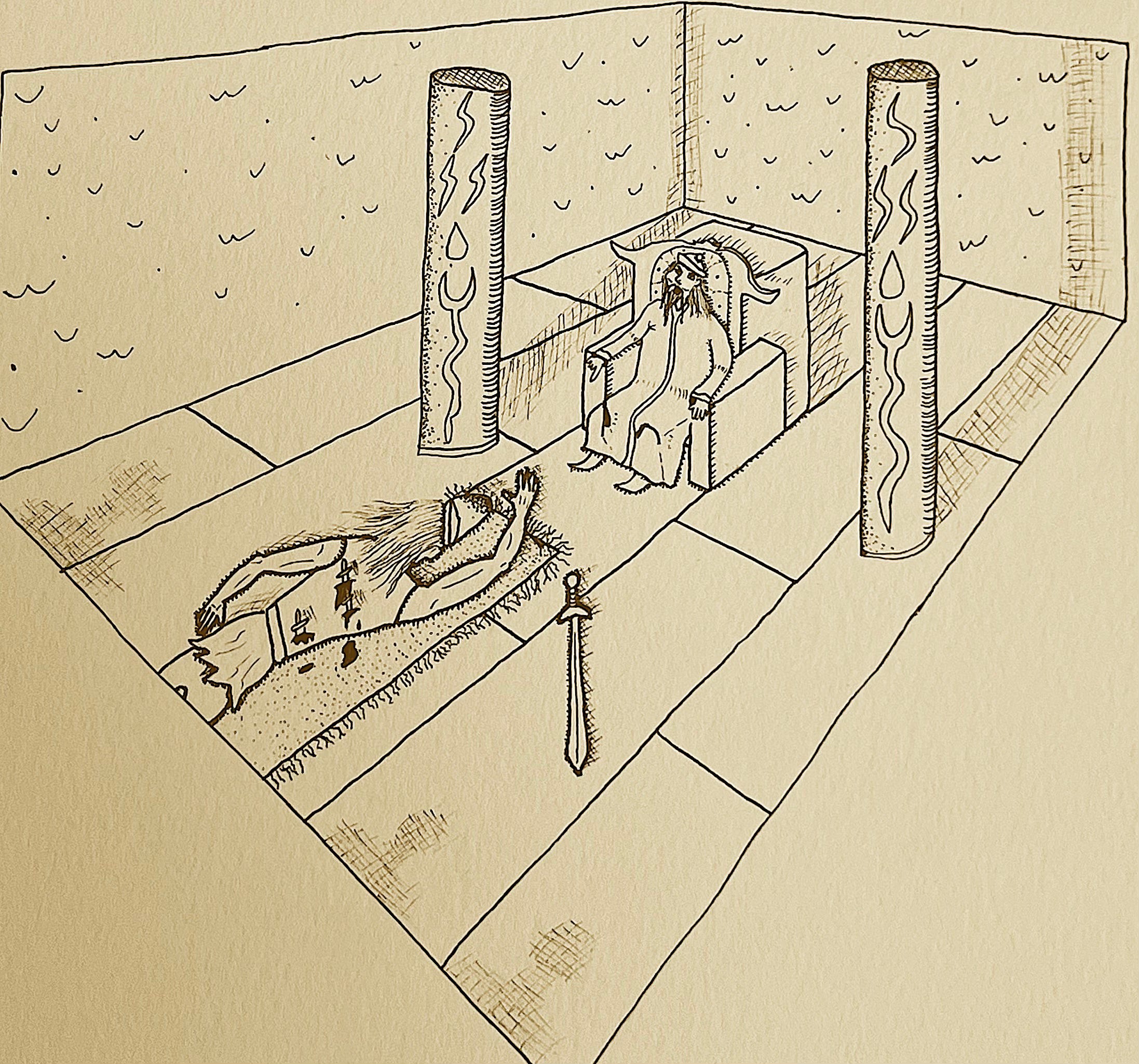
So, as you can see, the further the failed decision point is removed from the eventual consequence, the less it feels like the result of player agency. Scenario 1 created an immediate decision point simply because the DM used verbiage that made clear what the player was experiencing in the throne room. After all, we’re not looking for a “gotcha” moment. Scenario 2 was not as immediate with its clue, but the player still made a decision to act in spite of previous information warning against it. Now imagine if John had access to the clues from both these scenarios yet still acted rashly. He would doubly deserve his fate!
The Scenario 3 clue is a bit of a stretch, but at least the information was available had the players chosen to obtain it. Scenario 4 is not going to make anyone happy: yes, thanks, DM, we realize that all dungeons are dangerous and carry inherent risk, but we didn’t come here to role-play honest townsfolk. The decision of “adventure” or “not adventure” is not a meaningful decision in a game about adventuring.
Dice are for Non-Decisions
If players could just decide when to hit or miss with their attacks or decide to pass or fail their saving throws, then the game would be ruined; the choice is obvious, a “non-decision,” so it must be left to the dice to settle the matter even as the players do all they can to tip the scale in their favor. This logic works for the DM too, and it is why we have things like encounter reaction rolls. A softie DM would often decide to make the encountered entity be friendly, a harsh DM would usually make them attack, and while yet another DM might be constantly tailoring the reaction based on the relative condition of the party in an attempt to add challenge but avoid a TPK. Throw all that out and let the dice decide, unless it makes sense to modify the roll based on relevant decisions the players previously made.
Similarly, dropping anchor in a stormy bay might be a better player decision than sailing for the rocky shore, but a dice roll is still needed to see if the anchor holds; the players don’t get to decide if the anchorage is poor or the chain fails. Remember, the goal is not to replace decisions with dice rolls, but to use dice rolls where decisions are not appropriate for the desired game experience. I.e., dice determine the outcomes of forces beyond the purview of both players and DM.
Does this lead to scenarios where it looks like the dice have determined the player’s fate? Certainly it can look that way. However, if all these principles discussed have been observed, I think the table will generally agree that the outcome can be traced backward from the fateful dice roll all the way to a failed or successful decision point somewhere along the causal chain. The dice roll was just the final step in the sequence of resolving the player agency.
In the end, it is a DM’s respect for meaningful player decision-making that allows the running of an unforgiving, pull-no-punches game without seeming capricious or mean-spirited. The stereotypical “tyrant DM” is replaced with a just arbiter of the outcomes which result naturally from player decisions.
E. Gary Gygax, Advanced Dungeons & Dragons Dungeon Masters Guide (1979), 37, “Time in the Campaign.”
Great article Josh! I am always for letting the dice decide fate and informed decisions.